Choosing a smart ring manufacturer in China is not just a price comparison. A ring may look simple, yet its compact shell must hold sensors, a battery, charging contacts, and reliable wireless components. Small design choices affect comfort, measurement consistency, and battery life. On a sample, inspect the inner surface, clasp or charging fit, finish around sensor windows, and how securely the ring sits on different fingers.
A credible supplier should explain its role clearly: Does it design the product, assemble customer-owned designs, or handle both? Ask about prototyping, tooling, firmware support, quality checks, and production capacity. Request recent samples, a written specification, and evidence of relevant quality systems or testing. Then compare the sample with the promised production process. One attractive prototype proves little. A strong sample can still hide inconsistent components or a rushed inspection routine.
Communication matters, too. Notice whether the team answers technical questions directly, documents changes, and flags limitations before production. Ask how it tracks defects and manages revisions. Check references where practical, and agree on acceptance criteria before placing a substantial order. No checklist is perfect. A supplier may perform well on engineering but poorly on scheduling, or offer a low unit price with costly tooling and support. This guide explains how to assess those trade-offs, verify a manufacturer’s capabilities, and choose a partner whose claims match the details you can actually inspect.
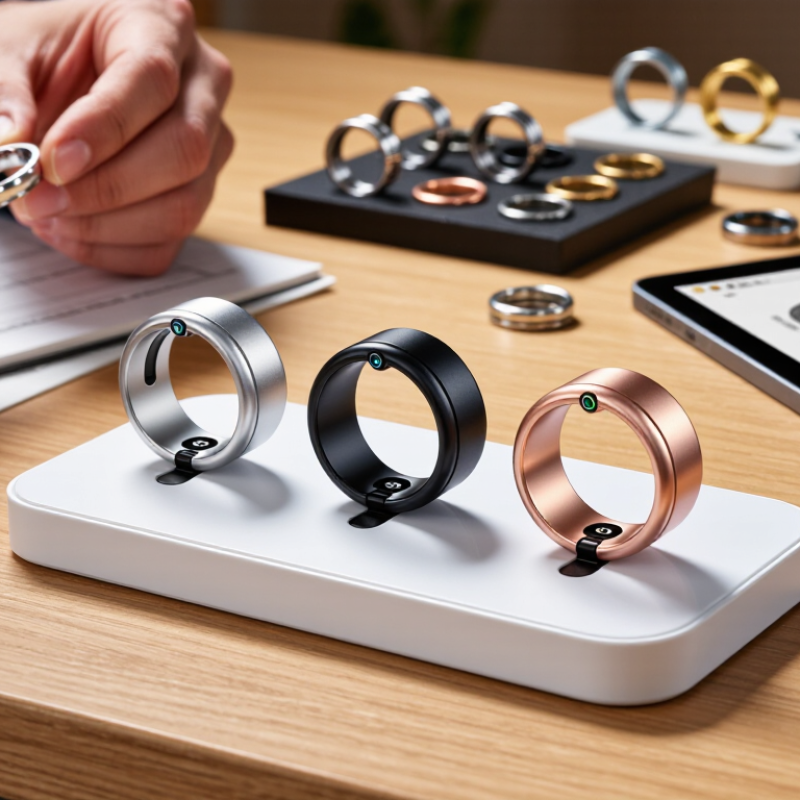
Define Smart Ring Requirements and Target Market Standards
Before contacting a smart ring manufacturer in China, define the user, use case, and target markets. Is the ring for sleep tracking, daily activity, or both? Specify finger sizes, battery life, sensor functions, app languages, and expected retail price. Grand View Research estimated the global smart ring market at USD 314.1 million in 2023, with projected annual growth of 24.1% from 2024 to 2030. This forecast signals opportunity, not guaranteed demand. Test your assumptions with buyers in each intended market.
Turn those needs into measurable requirements. For example, set a minimum battery life under continuous overnight monitoring, not only standby conditions. For skin-contact materials, ask whether relevant ISO 10993 assessments match the material and wearing duration.
For water resistance, request IEC 60529 test reports and confirm the rating applies to the complete ring. Small details matter. A coating change can affect comfort, durability, or test results.
Market rules vary. Identify radio, labeling, privacy, and product-safety requirements for every sales region, then ask suppliers for applicable certificates and test reports. Verify that documents cover the exact model and configuration you plan to order. Review sample data for sensor consistency across sizes and skin tones; one sample cannot prove production quality. I would also leave room for revision: early specifications often miss real-world charging habits. That is not ideal, but catching the gap before tooling is cheaper than correcting it later.
FAQS
Identify the intended user and use case, such as sleep tracking or daily activity. Specify ring sizes, sensor functions, app languages, battery life, and target retail price. Measure battery performance during overnight monitoring, not just standby. Forecasts suggest opportunity, not guaranteed demand.
Ask for skin-contact assessments that match the material and wearing duration. Request water-resistance reports for the complete ring, not just one component. Confirm documents cover your exact model and configuration. Small details matter.
Shenzhen offers access to electronics design and rapid prototyping. Dongguan has suppliers for precision machining, molding, and assembly. Huizhou may also be worth exploring. Location alone proves little.
Ask about experience with optical sensors, charging contacts, and waterproof enclosures. Find out who makes the circuit board, battery, and housing. Request an assembly explanation and sample rings. Responsibility can blur when several factories are involved.
Request its registered company name, business license, factory address, and current certificates. Check that certificates cover the relevant site and product scope. A live video tour or independent audit may reveal more than factory photos.
Compare several sizes for weight, finish, charging, sensor placement, and app behavior. Wear them during ordinary tasks. Check for rough inner edges and uneven charging pins. I would not trust one sample.
Ask similar customers about accuracy, delays, communication, and defect handling. Test charging repeatedly and compare readings across units. “Good service” is not a specific answer.
No. Request several units from a pilot batch. Record issues with photos and measurements, then agree on tolerances and rework costs in writing. No checklist catches everything. Some surprises remain.
Conclusion
Finding a top smart ring manufacturer in China begins with clearly defining your product requirements and target market standards. Consider the ring’s intended functions, materials, sizing options, design, performance expectations, and packaging needs before approaching suppliers. Then research manufacturing hubs and shortlist companies whose capabilities align with your project. A strong candidate should demonstrate relevant engineering expertise, consistent quality-control processes, suitable production capacity, and the ability to support product development as well as ongoing manufacturing.
Before making a commitment, verify the manufacturer’s credentials, request references, and assess product samples for workmanship and performance. Compare quotations, minimum order quantities, lead times, payment terms, and communication practices to understand the full commercial fit. Rather than relying on promises alone, place a carefully scoped pilot order to evaluate product consistency, coordination, and delivery. This step-by-step approach helps you choose a capable manufacturing partner and build a reliable foundation for future production.