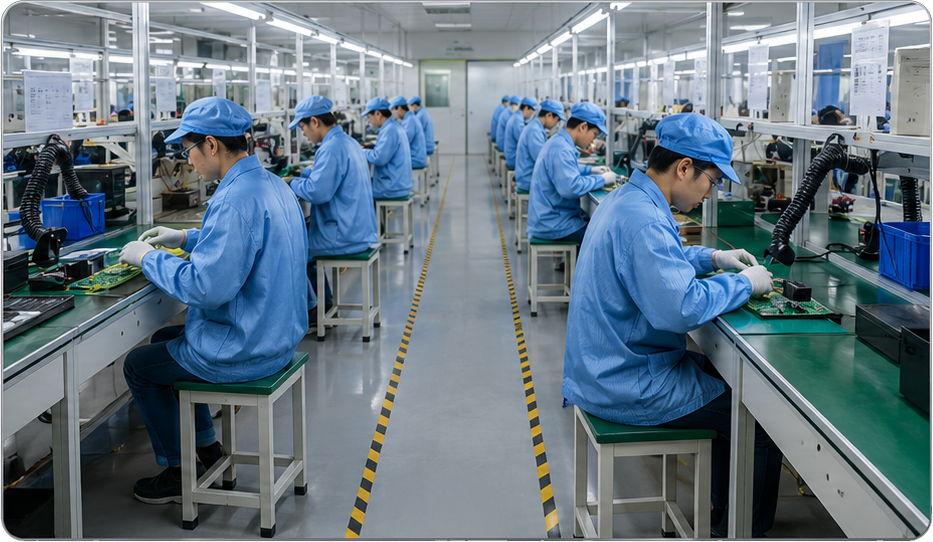






The Engineering and Testing Imperative in Wearable Hardware
In modern consumer electronics, wearable devices represent the pinnacle of volumetric packaging constraints. Unlike traditional mobile handsets or desk-bound electronics, devices such as medical-grade smart rings, AI waveguide smart glasses, and real-time translation earbuds are exposed to intense physical dynamics: continual dermal friction, synthetic perspiration, sub-zero and tropical temperature swings, hydrostatic pressure, and high-frequency tactile shocks. Consequently, tooling and testing is not merely a terminal checkpoint before packaging—it is the governing scientific architecture that dictates commercial success.
Global procurement executives and brand owners face severe pitfalls when sourcing from suppliers lacking vertically integrated test facilities. A nominal mold deviation of just 0.03mm can break the hermetic seal of a titanium-ceramic smart ring, causing catastrophic water ingress during routine swimming workouts. Similarly, inadequate electromagnetic compatibility (EMC) and radio frequency (RF) over-the-air (OTA) testing can attenuate Bluetooth Low Energy (BLE 5.4) range down to mere inches when worn next to dense human tissue.
Core Technical Axiom: The Information Gain in Wearable Testing
Precision testing bridges the physical-digital divide. Every micron saved in CNC and high-precision mold opening directly affects internal battery volumetric density and photoplethysmography (PPG) optical coupling efficiency. Rigorous testing protocols protect consumer brand equity and prevent multimillion-dollar recall actions in the North American, European, and Asian retail channels.
The 4-Stage Tooling, Engineering and Testing Matrix
At Shenzhen Yt Technology Co.,Ltc., every custom OEM/ODM program navigates an uncompromising 4-stage engineering verification cycle. By aligning industrial design (ID), mechanical engineering (MD), and printed circuit board assembly (PCBA) under one roof, we eliminate third-party subcontractor finger-pointing and guarantee full traceability across 28 rigorous inspection checkpoints.
EVT: Core Circuit & Logic
Focuses on component sanity, power management IC (PMIC) thermals, raw sensor bio-impedance capture, and baseline firmware logic.
DVT: Mold & Environment
Validates steel tooling cavities, CNC tolerance margins, ultrasonic housing bonding, salt-fog corrosion, and drop resistance.
PVT: Line Yield & ATE
Validates high-speed SMT placement, Automated Test Equipment (ATE) jig repeatability, firmware calibration burn-in, and yield stabilization >98.5%.
Mass QA: Outgoing Audit
Enforces MIL-STD-105E AQL II sampling, 100% optical leak testing, automated dark-current check, and complete batch serial mapping.
Comprehensive Test Parameters & Engineering Benchmark Matrix
To assist B2B purchasing agents in compiling request-for-proposal (RFP) technical requirements, our laboratory follows standardized benchmarks configured for international regulatory compliance:
| Validation Category | Engineering Test Method | Acceptance Standard | Hardware Impact |
|---|---|---|---|
| Ingress Sealing | Differential Air Decay & 5ATM Hyperbaric Tank | Zero pressure loss at 50m hydrostatic depth for 60 min | Guarantees IP68 / 5ATM swim-proof rating for rings and earbuds |
| Optical Bio-Sensors | Optoelectronic skin simulator phantom + Dark-room spectrometer | Heart Rate SNR > 25dB; SpO2 RMSE < 2.0% (vs. Medical Reference) | Eliminates motion artifacts across all skin tones (Fitzpatrick I-VI) |
| RF / OTA Antenna | 3D Anechoic Chamber TRP/TIS Measurement | Total Radiated Power (TRP) > +4 dBm; TIS < -92 dBm | Ensures uninterrupted audio and biometric data transfer to phone |
| Surface Biocompatibility | ISO 10993-5 / 10 Cytotoxicity & Skin Irritation | Zero cytotoxic release; hypoallergenic medical grade resin/titanium | Prevents consumer dermatological reactions during 24/7 continuous wear |
| Mechanical Fatigue | Tumble drop tester + micro-hinge actuator | 10,000 flex cycles for glasses hinges; 1.5m marble drop x 26 faces | Structural resilience against drops, daily flexes, and accidental crushes |
| Thermal Cycling | Dual-chamber thermal shock (-20°C to +60°C) | 100 cycles, 30 min dwell; no crazing, warping, or delamination | Ensures battery safety and circuit integrity in extreme climates |
Recommended Turnkey Platforms Engineered and Tested for Fast OEM/ODM Deployment
Sourcing teams looking to abbreviate lead times can capitalize on our verified, field-tested reference designs. These products have already completed initial tooling, EVT, DVT, and PVT qualification, allowing private-label clients to transition from logo customization to mass production in as little as 35 days:
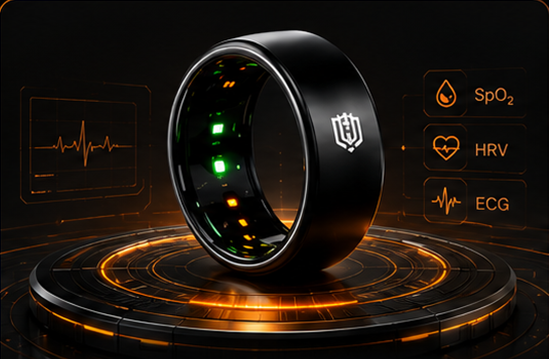
Private Label Health Smart Ring
Engineered with aerospace-grade titanium alloy and medical-grade bio-resin. Undergoes 100% 5ATM hydrostatic batch pressure testing, precision PPG multi-wavelength optical tuning, and wireless resonant induction charging validation.
- 5ATM / IP68 Fully Encapsulated Sealing
- Continuous HRV, SpO2, and Sleep Staging
- Ultra-low power Nordic BLE 5.4 Architecture
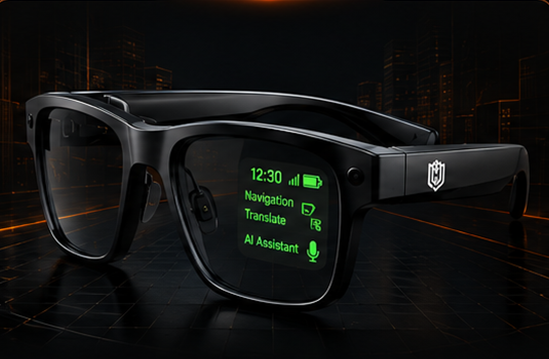
AI Voice & AR Display Glasses
Dual micro-OLED optical waveguide integration with precision hinge endurance testing. Calibrated using multi-axis collimation rigs for sharp binocular convergence, whisper-quiet beamforming mic array tuning, and balanced temple weight distribution.
- Diffractive Optical Waveguide Alignment
- Dual ENC Microphones with Noise Suppression
- Anti-torsion Titanium Spring Hinges
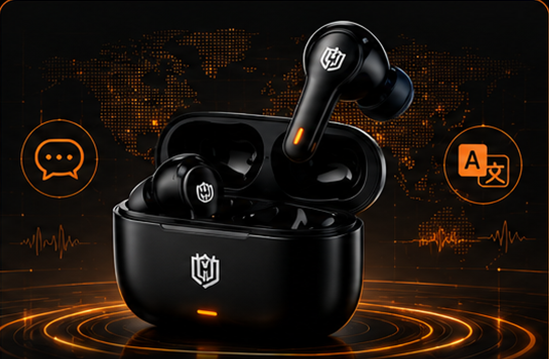
Real-Time AI Translation Earbuds
Acoustically tuned inside sound-isolated artificial ear simulators (B&K HATS). Fully tested for sub-150ms bidirectional translation latency, active environmental noise cancellation (ENC), and salt-sweat resistant charging contact pins.
- Dual-Channel Low Latency Audio Streaming
- PVD Corrosion-Proof Gold Contacts
- High-Dynamic Dynamic Transducers
Future Procurement Trends in Wearables: What Buyers Must Prepare For
Sourcing teams must anticipate transformative shifts driven by artificial intelligence and regulatory scrutiny over the next 24 to 36 months:
- Stringent Dermal and Chemical Compliance: Regulatory bodies in Europe and North America are expanding restricted substance lists (e.g., PFAS, nickel release, and specific plasticizers). Sourcing contracts will increasingly stipulate gas chromatography-mass spectrometry (GC-MS) laboratory verification as part of incoming raw material acceptance.
- On-Device Machine Learning (TinyML) Algorithm Verification: Testing is moving beyond physical continuity into sensor algorithmic fidelity. Buyers will require suppliers to demonstrate that on-board microcontrollers correctly compute atrial fibrillation detection or sleep stage transitions under diverse physical movement parameters without heavy cloud offloading.
- Automated Optical Inspection (AOI) with AI Machine Vision: Manual microscopic inspection of micro-welds and resin fill boundaries is rapidly becoming obsolete. High-volume procurement programs now prefer automated multi-camera machine vision stations that scan for sub-surface bubble inclusions and solder bridging down to 5-micron resolutions.
- Circularity and Battery Repairability Mandates: Forthcoming EU battery regulations necessitate eco-design considerations even in ultra-compact wearables. Factories must pioneer specialized disassembly tooling and non-destructive battery release mechanisms that still preserve hermetic IP68 performance.
Product Technology and Development Trends
The smart wearable industry is transitioning from speculative novelty gadgets to indispensable daily health monitoring nodes and conversational AI interfaces. Understanding these underlying technological vectors helps procurement directors make future-proof ODM tooling investments:
- Titanium-Ceramic Hybrid Tooling: High-end smart rings are increasingly moving away from pure plastic frames to multi-shot metal-injection molding (MIM) combined with zirconia ceramic outer bands. This requires specialized diamond-tooled CNC machines and custom sintering thermal profiles to prevent micro-cracks.
- Full-Color Micro-LED Waveguide Assemblies: In AI smart glasses, green-monochrome displays are giving way to high-luminance, full-color micro-LED displays capable of exceeding 2,000 nits. Tooling for optical waveguide frames requires nanometer-scale precision to prevent angular chromatic aberration and parallax strain.
- Integrated Multi-Spectrum Photoplethysmography: New health tracking rings now combine green (heart rate), red and infrared (pulse oximetry), and yellow/orange wavelengths (blood perfusion) to extract blood pressure indicators and arterial stiffness metrics. This demands precise optical light-guide barriers inside the ring tooling to eliminate optical cross-talk.
- Multi-Microphone Spatial Audio & Beamforming: AI translation earbuds rely heavily on acoustic isolation cavities inside the earbud shell. Micro-tooling for acoustic mesh filters and internal resonance chambers directly dictates beamforming clarity in chaotic airport and exhibition environments.
Have a Custom Wearable Design Requiring Feasibility Analysis?
Submit your 3D CAD step files or functional specs under NDA. Our engineering team will deliver a comprehensive Design for Manufacturing (DFM) assessment and automated testing plan within 24 hours.

Why Global Procurement Leaders Partner with Shenzhen Yt Technology Co.,Ltc.
Established in 2009 in Shenzhen, China, Shenzhen Yt Technology Co.,Ltc. has evolved into a premier contract manufacturer specializing in high-density smart wearables and AI hardware. Our vertically integrated infrastructure bridges design, rapid prototyping, precision tooling, cleanroom SMT assembly, and strict testing protocols under a single ISO 9001-certified roof.
- 15+ Years of Dedicated Hardware Expertise: Since 2009, we have translated disruptive wearable concepts into mass-produced devices sold across 40+ countries.
- Formidable Engineering Brainpower: Over 5 senior R&D directors oversee hardware architecture, embedded firmware, RF tuning, and proprietary cross-platform iOS/Android companion app integration.
- Uncompromising Production Scale: Operating 8 lean assembly lines and 2 high-speed Yamaha SMT placement lines staffed by 100+ skilled operators, generating a steady capacity exceeding 300,000 units monthly.
- Intellectual Property & Patent Portfolio: With over 50 invention, utility model, and structural patents granted, our clients benefit from legally sound, proprietary engineering architecture.
- Stringent Quality Governance: With 28 rigorous inspection checkpoints across raw material acceptance (IQC), in-process testing (IPQC), functional testing (FQC), and outgoing audit (OQC), our finished batch defect rate is consistently maintained below 5‰.
- Total IP Protection Under Strict NDA: We operate segregated production cells and dedicated project teams, ensuring your proprietary industrial designs, tooling geometries, and firmware binaries are held in strictest confidence.
- Full International Certification Compliance: Our engineering team designs from day one to clear CE, FCC, RoHS, and UKCA certifications, ensuring friction-free global customs clearance and retail distribution.