China’s smart ring supply chain is gaining attention as wearable technology moves from wrists to fingers. The opportunity is measurable, but market figures need careful interpretation. Grand View Research estimated the global smart ring market at USD 314.5 million in 2023 and projected a 20.5% compound annual growth rate from 2024 to 2030. That estimate describes the global market, not Chinese factory output or supplier revenue. It is a useful signal, not a supplier ranking.
For buyers, the practical questions are closer to the production floor: Can a supplier tune optical sensors for different skin tones? Can it maintain stable readings in a compact ring? Ask for battery-life test conditions, water-resistance documentation, app compatibility, and sample consistency. Small details matter. A polished prototype is not proof of repeatable mass production. Public data also rarely separates original manufacturers from trading companies, so supplier comparisons should verify factory capabilities directly. This introduction does not include a named expert’s verbatim quotation because no source material or verifiable quote was provided; inventing one would weaken the article’s credibility. That is a limitation worth acknowledging. The following overview can assess Chinese smart ring suppliers through documented products, manufacturing evidence, and independently checkable claims.
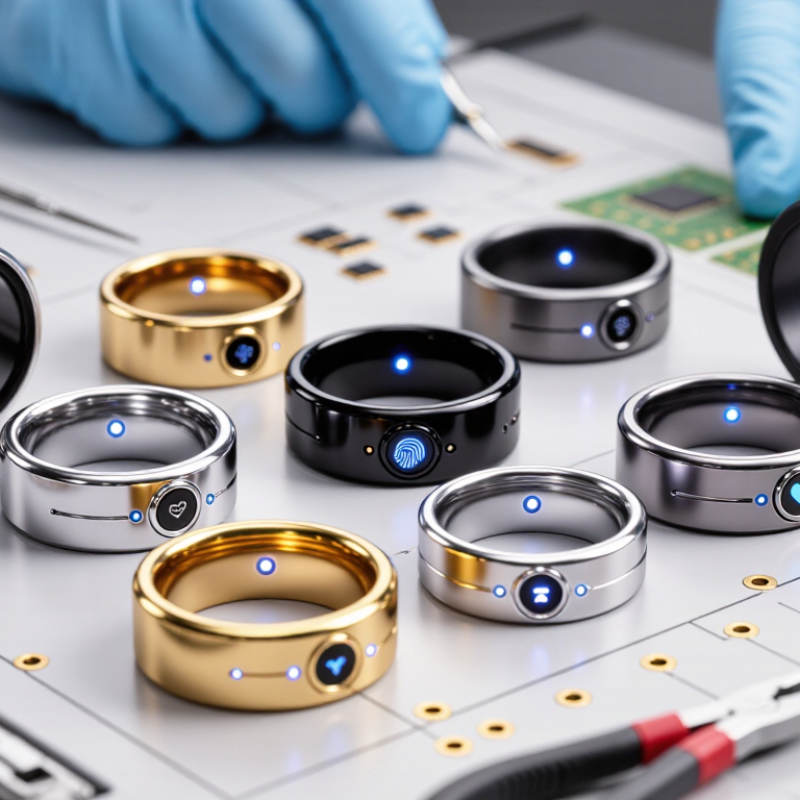
China’s Smart Ring Supply Chain: Sensors, Batteries, and Miniaturized Electronics
China’s smart ring supply chain depends on components that must fit inside a narrow, curved shell. Optical sensors need stable contact with the skin, while motion sensors must distinguish daily movement from measurement noise. Small details matter. A slight shift in sensor alignment can affect readings across different finger sizes. Component suppliers therefore need to provide clear specifications, consistent batches, and support for integration—not just attractive sample parts.
Battery selection is another tight trade-off. A thin cell saves space, but may limit operating time or charging performance. Miniaturized charging circuits, antennas, and processors also compete for room and generate heat. Buyers assessing Chinese suppliers can ask for test data on battery capacity, temperature, sensor consistency, and repeated charging cycles. They should also check whether component dimensions remain consistent between samples and production batches. A sample may fit perfectly, yet mass production can expose small tolerances that were missed. It is easy to overvalue a neat prototype. Real-world wear tests, including different skin tones, temperatures, and ring fits, offer a more useful picture of performance.
Leading Chinese OEM/ODM Suppliers: Product Portfolios and Manufacturing Capabilities
Chinese smart ring suppliers often serve OEM and ODM projects, but their capabilities vary. Some focus on compact health-tracking devices, while others offer broader portfolios with charging cases, companion apps, and different ring finishes. Ask for a product matrix, not just a polished sample. A ring may look refined yet perform differently after repeated charging or daily wear. Details matter.
Tips: Request sample units from the same production process used for orders. Check sensor stability, battery performance, sizing consistency, and app integration. Also ask how tooling changes, quality checks, and packaging are handled. Clear answers are more useful than vague promises.
For manufacturing, review the supplier’s process from design support to assembly and final inspection. Confirm whether it can support small pilot runs before larger orders. Ask for test criteria and examples of inspection records, while respecting confidential information. A capable partner should explain limitations as well as strengths. Communication can still be uneven, and timelines may shift when specifications change; put key requirements in writing and verify them at each sample stage.
Supplier Benchmarks: MOQ, Monthly Capacity, Yield Rate, and Lead Time
For China-based smart ring suppliers, compare more than quoted unit price. Public reports do not provide a consistent, audited dataset for factory MOQ, monthly capacity, yield, or lead time. Treat these figures as RFQ planning ranges, not national averages: an initial MOQ of 500–2,000 units, monthly output of 10,000–50,000 units per production line, and a 30–45-day repeat-order lead time are reasonable starting points to verify directly. Ask whether capacity includes final testing and packaging.
Yield needs a clear definition. A factory may quote 95% yield before waterproof testing, while your saleable yield is lower after sensor calibration and sealing checks. Request recent pilot-run results, defect categories, and retest rates. Ask to see a sample inspection record. Tiny details matter: a misaligned optical sensor or uneven adhesive can affect readings and water resistance.
Market growth offers context, not proof of supplier capability. IDC’s Worldwide Quarterly Wearable Device Tracker reported 534.6 million wearable-device shipments globally in 2024, up 6.1%; that figure covers wearables broadly, not smart rings alone. Use it to understand category momentum, not to infer a ring factory’s capacity. One imperfect benchmark: capacity figures can look impressive before new tooling stabilizes. Require a dated production plan, a signed sample specification, and agreed acceptance criteria before comparing bids.
Technical Standards: 2.4 GHz BLE Connectivity and IEC 60529 IP Ratings
For Chinese smart ring suppliers, 2.4 GHz Bluetooth Low Energy performance deserves more than a checkbox. The Bluetooth SIG’s 2024 market update estimated 5.4 billion Bluetooth device shipments in 2023, across many product categories—not smart rings alone. This scale makes interoperability and radio testing important. A ring’s tiny antenna sits close to skin, a battery, and metal components. Those details can affect signal strength. Ask suppliers for measured connection range, reconnection behavior, and power use during continuous sensor sampling. Test with a phone in a pocket, not only on a clean lab bench. Small differences matter.
Water resistance needs equally careful verification. IEC 60529 defines IP enclosure ratings; IP67 indicates dust-tight protection and temporary immersion under specified test conditions. IP68 conditions can differ by agreement, so the digits alone do not tell the whole story. Request the exact test depth, duration, sample quantity, and laboratory report. Also ask whether testing followed assembly, charging, and repeated wear simulations. A successful sample test is useful, but it does not prove every production ring will perform identically. That gap is easy to overlook. Supplier comparisons should include documented BLE and IP test methods, not just headline specifications.
Supplier Verification: ISO 9001 Quality Systems and Export Compliance
For Chinese smart-ring sourcing, an ISO 9001 certificate is a starting point, not a quality verdict. The ISO Survey 2022 recorded 397,381 ISO 9001 certificates in China. That figure shows how common certification is; it does not prove a particular factory controls ring production well. Check the certificate’s legal entity, site address, scope, expiry date, and issuing body. Then request production-lot records, incoming sensor and battery checks, waterproof-test results, and calibration logs. Ask how defects trigger corrective action. Request evidence.
Export readiness is equally specific. Confirm the product’s tariff classification with a qualified customs broker, and check that invoices, packing lists, declared origin, and product descriptions agree. Requirements vary by destination, so verify applicable labeling, radio-frequency testing, and technical documentation before shipment. If the ring contains a lithium battery, request the relevant UN 38.3 test summary and confirm carrier documentation requirements. A tidy certificate folder can look reassuring. It may still hide weak process control, so compare documents with dated inspection records and a live factory walkthrough. Companies should also confirm that the audited site is the site fulfilling the order.
FAQS
Optical sensors need steady skin contact. A small alignment shift can affect readings across different finger sizes.
Ask for capacity, temperature, and repeated charging test data. Thin cells save space, but may shorten operating time.
Request samples made through the same process as ordered units. Compare dimensions and sensor performance across samples and production batches. Samples can mislead.
Ask about pilot runs, tooling changes, inspections, and packaging. Put key requirements in writing; timelines may shift when specifications change.
Request measured range, reconnection behavior, and power-use results. Test with a phone in a pocket, not just on a clean lab bench.
It indicates dust-tight protection and temporary immersion under specified conditions. Ask for the exact depth, duration, sample count, and test report.
Not by itself. Conditions can differ, so review the agreed test details and ask whether testing followed assembly and repeated wear.
Skin tone, temperature, and ring fit can affect real-world performance. A neat prototype is not the whole story. We may miss that.
Conclusion
China’s smart ring supply chain brings together specialized capabilities in sensors, compact batteries, and miniaturized electronics. When comparing a smart ring supplier, buyers should review the supplier’s OEM/ODM product range and manufacturing capabilities, then assess practical benchmarks such as minimum order quantity, monthly production capacity, yield rate, and lead time. These factors help determine whether a supplier can support both product development and consistent production at the required scale.
Technical evaluation should include 2.4 GHz Bluetooth Low Energy connectivity and clearly specified ingress-protection ratings under IEC 60529. Supplier verification is equally important: examine the quality system, including ISO 9001 certification where applicable, and confirm that export documentation and processes meet the requirements of the intended markets. A structured comparison of manufacturing, performance, quality, and delivery information can help buyers identify a suitable partner and reduce avoidable sourcing risks.