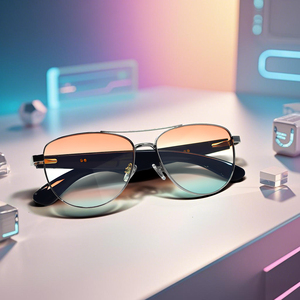
1. The Paradigm Shift in Heads-Up Navigation: Why Smart Glasses Are Displacing Handheld Devices
In modern logistics, urban micro-mobility (e-bikes, electric scooters), cycling, and enterprise field services, glancing down at a 6.7-inch smartphone screen creates a critical visual blind spot lasting between 1.5 to 2.8 seconds. At 25 km/h, a rider traverses over 19 meters without situational optical feedback. OEM/ODM smart glasses with integrated navigation resolve this safety-critical friction by projecting contextual, collimated turn-by-turn vectors directly into the user’s forward field of view (FOV).
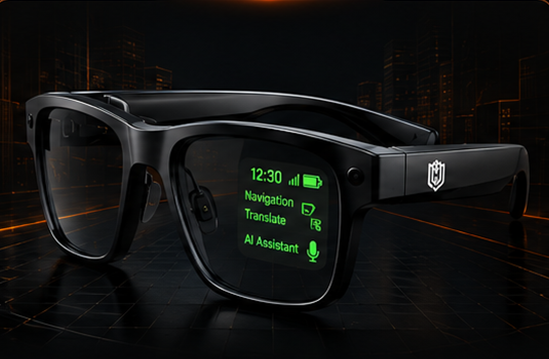
Unlike full-immersion augmented reality (AR) headsets that require cumbersome binocular projection and weigh upward of 120 grams, lightweight navigation smart glasses operate on a strictly glanceable heads-up display (HUD) philosophy. The hardware objective is to present spatial telemetry—such as directional azimuth arrows, distance-to-next-turn countdowns, velocity indicators, and elevation gradients—without obscuring road hazards or causing accommodation asthenopia (eye strain).
Ergonomic Optical Requirements for Outdoor Glancing
Designing navigation smart glasses demands strict optical threshold balancing. Ambient daylight on paved roads can easily exceed 50,000 to 100,000 lux. Traditional OLED or TFT beam splitters wash out completely under direct noon sunlight, forcing the user to strain.
- Eye-Level Luminance: > 1,500 nits output through the waveguide exit pupil
- Optical Transmittance: > 85% clear see-through glass for ISO 12312-1 compliance
- Virtual Image Distance (VID): Collimated projection at 2.5m to 3.0m infinity focus
2. Optical Engine Architectures: Diffractive Waveguides vs. Micro-Prisms
As an established tier-1 smart wearable ODM/OEM supplier in Shenzhen, YT Smart Wear provides our brand clients with deep component-level insight during early product definition. The choice of the optical combiner defines the frame geometry, BOM cost, industrial design (ID), and total optical efficiency.
| Architecture Matrix | MicroLED + Diffractive Waveguide | MicroOLED + Freeform Birdbath | Geometric Reflective Array |
|---|---|---|---|
| Display Light Engine | Monochrome Green / Full-Color MicroLED (<0.13 cc) | 0.49" MicroOLED Panel (>1.2 cc) | Monochrome / RGB MicroLED / LCoS |
| Peak Luminance at Source | Up to 3,000,000 nits | 3,000 – 5,000 nits | 50,000 – 100,000 nits |
| Eye-Box Dimensions | 12 mm × 10 mm (Superior forgiveness) | 8 mm × 6 mm (Sensitive to slippage) | 10 mm × 8 mm |
| Total Lens Thickness | 1.2 mm to 1.8 mm (Resembles standard lens) | 12 mm to 16 mm (Bulky, outward offset) | 2.0 mm to 3.0 mm |
| Ambient Transmittance | 85% - 90% (Zero sunglass tint needed) | 25% - 40% (Heavy polarization tint required) | 75% - 80% |
| BOM Cost Delta | Higher NRE & unit substrate cost | Moderate / High yield maturity | High manufacturing complexity |
For navigation-specific consumer and industrial applications, Surface Relief Grating (SRG) diffractive waveguides coupled with monochrome green MicroLED engines currently offer the optimal Pareto frontier. Monochrome green (525nm peak wavelength) matches human photopic spectral sensitivity (V(λ)), delivering unmatched contrast under direct sunlight with less than 120mW display driver consumption.
3. RF Hardware, Telemetry Fusion & Sensor Architecture
A standalone GPS receiver operating continuously at 10Hz updates will drain a miniature 180mAh wearable lipo battery within 90 minutes. Therefore, engineering navigation smart glasses requires an elegant distribution of compute, telemetry, and power budgets between the edge glasses hardware and the paired iOS/Android companion application.
Dual-Core Low-Power Wireless MCU
Utilizing Nordic nRF5340 or BES2700 platforms with dual Arm Cortex-M33 cores. One core handles isolated Bluetooth 5.4 LE Audio and data packet routing, while the dedicated network core executes real-time HUD rendering.
9-Axis IMU & Dead Reckoning Fusion
Bosch or STMicroelectronics ultra-low-power accelerometer, gyroscope, and magnetometer with on-chip sensor fusion. Keeps turn arrows locked to spatial headings during satellite multipath signal degradation in urban canyons.
Acoustic Beamforming Prompts
Dual omnidirectional MEMS microphones paired with directional open-ear micro-speakers. Delivers crystal-clear conversational turn advisories ("Turn right on King St in 50m") audible at 30km/h cycling wind noise.
4. Thermal Dissipation, Battery Balance & Mechanical Tooling
Consumer wearability hinges upon center-of-gravity ergonomics. If the front frame weight exceeds 30 grams, the glasses slip uncomfortably down the nasal bridge. Furthermore, regulatory standards (such as IEC 62368-1) impose a strict contact surface temperature cap of 41°C at the temple tips touching human temporal skin.
Dual-Temple Symmetrical Weight Distribution
YT Smart Wear resolves front-heaviness through a split-component industrial architecture:
- Left Temple: Primary Main PCBA, Bluetooth SoC, Flash memory, PMIC, and optical engine FPC ribbon connectors.
- Right Temple: High-density cobalt-lithium fast-charge cell (160–220mAh) with dedicated BMS safety circuits.
- Hinges: Patented spring-loaded flexible hinges with internal multi-core flexible flat cables (FFC) rated for 30,000+ cycle fatigue tests.
5. Future Sourcing Trends in Navigation Smart Glasses (2025–2030)
When procuring next-generation eyewear hardware, enterprise procurement officers and brand founders should evaluate emerging component roadmaps to prevent premature product obsolescence:
1. Full-Color Monolithic MicroLED Engines
Transitioning from red-green-blue multi-chip stacking to monolithic quantum dot (QD) color conversion, expanding graphical HUD maps from basic wireframe arrows into high-definition topographic route maps under sub-150mW power profiles.
2. Edge-AI Landmark Navigation & Vision POI
Integrating ultra-compact 5MP/8MP camera sensors with low-power Neural Processing Units (NPUs). The glasses visually recognize building entrances, storefront addresses, or industrial warehouse bin locations and pin floating target markers over the user's vision.
3. Prescription Lens Bonding Integration
Direct optical adhesive lamination of refractive corrective prescription inserts (Myopia/Astigmatism) bonded directly onto diffractive waveguide glass substrates without creating double-image ghosting or optical birefringence.
6. Factory Production Engineering & Quality Assurance Capabilities
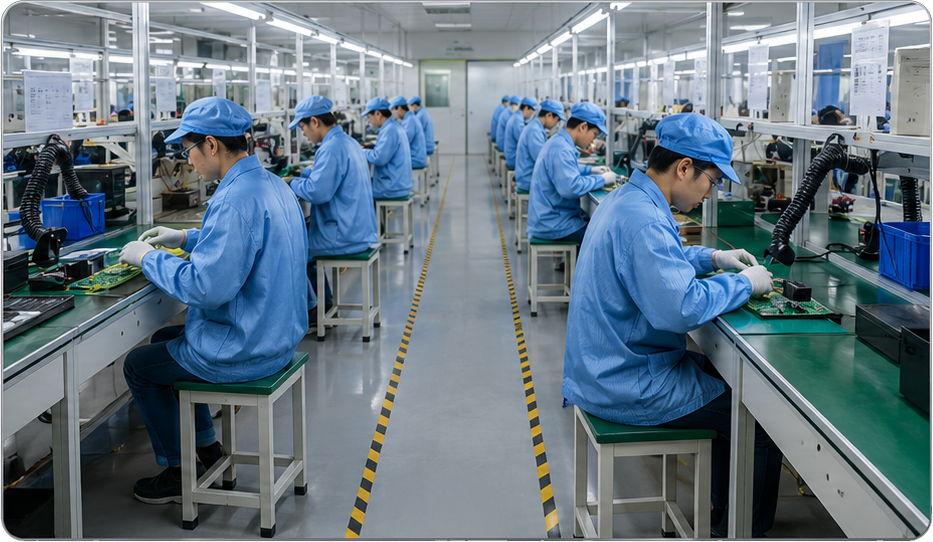
Headquartered in Shenzhen, China's core electro-optical manufacturing ecosystem, Shenzhen Yt Technology Co., Ltd. (YT Smart Wear) has served world-class consumer electronic and medical brands since 2009. We offer end-to-end turnkey hardware creation—from initial Industrial Design (ID) sketch, Structural Engineering (MD), SMT high-speed circuit assembly, cleanroom optical module bonding, through to automated testing and export customs clearance.

Turnkey OEM/ODM Quality Milestones
Unlike trading entities that outsource production to fragmented third-party workshops, our fully owned infrastructure guarantees end-to-end traceability and strict engineering rigor across 28 distinct inspection checkpoints.
- Cleanroom Assembly: Class 10,000 optical dust-free environment for micro-display and waveguide bonding.
- Precision SMT: 2 high-speed Siemens / Panasonic SMT lines placing 01005 components with high yields.
- Environmental Stress Screening: 48-hour high-low temperature (-20°C to +60°C) cycling, salt-fog corrosion, and tumble drop validation.
- Global Compliance: Full internal pre-compliance testing for CE (RED), FCC Part 15C, RoHS, REACH, and UN38.3.

Global Reach & Software SDK Delivery
Hardware is only half the battle; real-time navigation relies on stable client-side software. We supply white-label iOS and Android companion SDKs equipped with Mapbox, Google Maps, or Baidu Maps telemetry parsing modules.
Whether your project requires custom Bluetooth low-energy GATT profiles for turn data transmission, OTA cloud server setup, or custom private-label branding, our engineering division delivers fully documented API bridges and firmware source code licensing.
7. Frequently Asked Questions (FAQ) for OEM/ODM Buyers
What is the typical Minimum Order Quantity (MOQ) for custom navigation smart glasses?
For pre-tooled, turnkey white-label orders using our validated optical chassis (customizing only temple logo silkscreen, custom boot-up display graphics, and retail packaging), our MOQ starts at 500 to 1,000 units. For full ODM bespoke projects involving custom industrial design, plastic tooling, and custom optical wave-guide layout, our MOQ starts at 3,000 units with milestone tooling NRE amortization.
How does the navigation engine synchronize with mobile mapping APIs?
Our software stack communicates via an optimized BLE 5.3/5.4 data channel. The companion application retrieves route instructions from Google Maps or Mapbox, serializes directional vectors, turn maneuver flags, icon bitmaps, and countdown metrics into compact 20-byte data packets, and transmits them to the glasses RTOS at 100ms intervals without overloading memory buffers.
What is the average sample turnaround and mass production lead time?
Standard functional engineering samples of our existing navigation platforms ship in 5 to 7 business days. Full custom ODM projects require approximately 25 to 35 days for ID/MD finalization and Rapid 3D CNC mockups, 40 to 50 days for mold tooling and EVT (Engineering Validation Test) units, and 35 to 45 days for final mass assembly following DVT/PVT approvals.
How do you address water ingress and sweat protection for sports use?
Outdoor navigation devices face persistent moisture, rain, and acidic human sweat. We integrate specialized waterproof acoustic vent membranes (e.g., Gore acoustic mesh) over mic/speaker apertures, apply automated nanoscale hydrophobic conformal coatings across internal PCBA assemblies, and seal chassis joints with UV-curable structural adhesives, reaching standard IPX4 to IPX7 ingress ratings.
How do you safeguard client intellectual property (IP) and proprietary designs?
Before project scoping begins, we sign legally binding bilateral Non-Disclosure Agreements (NDAs). Custom mold toolings, bespoke firmware encryption keys, and companion app UI assets are maintained under air-gapped internal servers. Custom injection tooling remains the exclusive property of the buyer and is never repurposed for open-market catalog manufacturing.
What international certifications and compliance paperwork do you provide?
All production units are manufactured under ISO 9001 certified protocols. We assist buyers directly with accredited test laboratory reports (SGS, TUV, Intertek) for CE-RED, FCC ID, RoHS 2.0, REACH, UKCA, and WEEE. Batteries ship with mandatory UN38.3 test summaries, 1.2m drop test compliance, and MSDS clearance documentation for hassle-free sea and air freight logistics.