Production-Ready Smart Ring & Wearable Form Factors
Engineered for high algorithmic accuracy, ergonomic skin contact, ultra-low standby power, and rapid firmware customization.
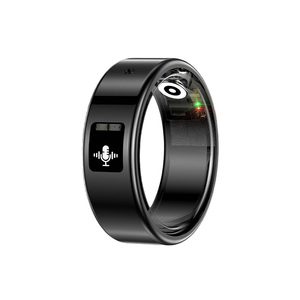
AI Interview Smart Ring with Voice Transcription Support
- Dual-mic noise cancellation array
- Real-time speech-to-text algorithm integration
- Medical resin hypoallergenic inner liner
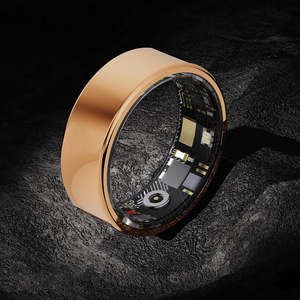
Smart Ring Sleep & Fitness Monitoring Health Tracker
- Multi-wavelength PPG (SpO2 + HRV)
- REM, deep, and light sleep analysis
- 7-day lithium polymer battery endurance
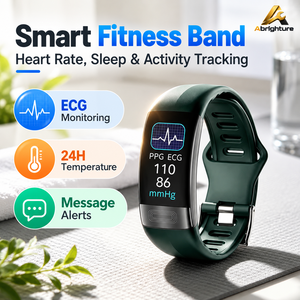
Clinical-Grade ECG & 24H Temperature Smart Band
- Single-lead ECG contact electrode
- Continuous NTC skin temperature sensor
- IP68 continuous immersion certified
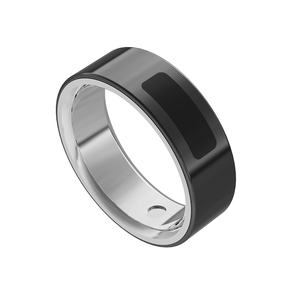
5ATM Waterproof Gesture-Control Health Ring
- Surgical stainless steel outer chassis
- 6-axis IMU spatial gesture recognition
- 50-meter hydrostatic pressure tolerance
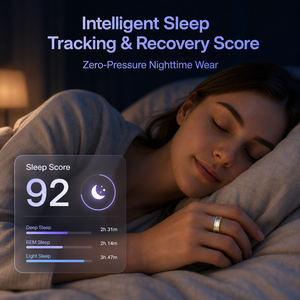
OEM Titanium Aerospace-Grade AI Smart Health Ring
- Ultra-lightweight Ti-6Al-4V titanium alloy
- PVD scratch-resistant nano-coating
- Customized private label packaging & SDK
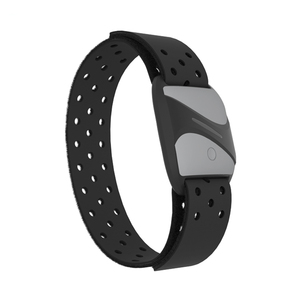
Dual Bluetooth & ANT+ Optical Armband Sensor
- High-intensity exercise heart rate tracking
- Seamless sync with gym systems and GPS units
- IP67 magnetic snap charging terminal
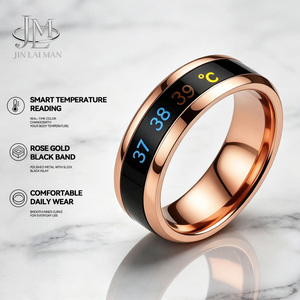
Stainless Steel Smart Thermosensing Wellness Ring
- Dynamic ambient & basal thermal monitoring
- Jewelry-grade mirror polished beveling
- Accessible unit economics for promo retail
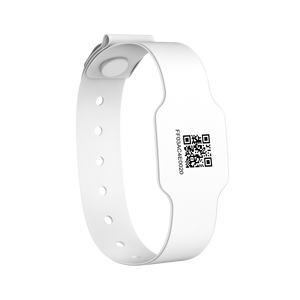
Hospital RFID & NFC Realtime Location Beacon Bracelet
- BLE 5.0 long-range telemetry gateway
- Integrated passive RFID + active NFC
- Hospital patient ID compliance design
B2B Procurement Trends in the China Smart Ring Ecosystem
Market requirements for smart rings have matured beyond basic step-counting. Procurement leaders evaluate vendors based on the following three paradigm shifts.
Clinical-Grade Precision & Edge-AI Firmware
Global consumer electronics distributors are pivoting away from non-calibrated sensors. Modern supply contracts demand multi-wavelength photoplethysmography (green, red, and infrared PPG) combined with onboard edge-AI algorithms capable of running artifact suppression directly on Nordic or Ambiq low-power MCUs. This ensures sleep-stage scoring, atrial fibrillation risk alerting, and peripheral oxygen saturation (SpO2) meet medical pre-compliance benchmarks.
Turnkey Cloud Ecosystem & Private Label SDKs
Procuring raw hardware without robust software is a critical operational bottleneck. Enterprise brands now demand complete white-label architectures: localized iOS and Android applications, source-code SDK access for healthcare enterprise integration, and HIPAA/GDPR-compliant AWS or Azure cloud backends. Sourcing partners in Shenzhen must offer end-to-end API pipelines that allow turnkey rebranding and rapid market deployment.
Biocompatible Materials & Complex CMF Engineering
Smart rings present demanding structural challenges: components must endure continuous sweat contact, mechanical friction, and accidental impacts while remaining under 4 grams. The supply chain has shifted toward aerospace-grade titanium alloy (Grade 5) outer shells treated with Physical Vapor Deposition (PVD) or Diamond-Like Carbon (DLC) coatings, bonded via seamless secondary injection molding to skin-safe, medical-grade epoxy resins.
Technological Evolution of Smart Ring Subsystems
A granular look at the architectural migrations dominating next-generation factory production lines.
High-Density Flexible Batteries
Traditional cylindrical batteries have given way to curved, high-energy-density solid-state and polymer cells. Modern cells deliver 18mAh to 24mAh capacities in profiles under 2mm thickness, enabling 5 to 7 days of continuous monitoring with intelligent charging algorithms that preserve battery capacity over 500 charge cycles.
Contactless NFC & Identity Verification
Security and micro-transaction features are converging within ring architectures. By embedding ultra-compact, high-permeability ferrite NFC coils alongside secure element (SE) chips, smart rings now support encrypted access control, digital key virtualization, and contactless POS payments without compromising biosensing accuracy.
Rigid-Flex PCB & Ultra-Miniaturized SMT
Smart ring circuit design requires high-density interconnect (HDI) rigid-flex substrates engineered with 01005 passive components and Wafer-Level Chip-Scale Packaging (WLCSP). Automated 3D optical and X-ray inspection is mandatory to prevent cold solder joints across curved, stress-bearing areas.
Why Global Brands Source From Shenzhen YT Technology
Operating continuously since 2009, Shenzhen Yt Technology Co., Ltd. provides a vertically integrated manufacturing ecosystem for smart rings, AI glasses, and advanced biosensing wearables.
End-to-End In-House R&D
From initial ID definitions, structural CAD, and precision mold tooling to embedded RTOS firmware, algorithmic tuning, and companion app engineering, projects remain under a single accountable engineering unit.
High-Volume SMT & Cleanrooms
Our facility hosts 8 dedicated assembly lines and 2 automated high-speed SMT lines backed by cleanroom encapsulation environments, ensuring stable delivery of over 300,000 units per month.
28-Point QC & Global Approvals
Production follows an ISO 9001 certified quality architecture with 28 strict quality checkpoints. Finished goods comply with CE, FCC, RoHS, and UKCA standards for friction-free customs clearance.
IP Security & Fast Turnaround
Rigid non-disclosure protocols protect customer ID designs and proprietary codebases. Rapid prototyping delivers functional proof-of-concept samples in ~7 days, with bulk production delivered in ~35 days.
Frequently Asked Questions for Smart Ring Sourcing
Essential guidance for supply chain managers, brand directors, and procurement specialists.
What are the typical Minimum Order Quantities (MOQs) for smart ring OEM vs. ODM contracts?
How does the factory resolve ring sizing challenges for global retail distribution?
What specific biosensing metrics can your smart ring platforms reliably extract?
How is IP68 / 5ATM waterproofing achieved on complex resin-bonded rings?
What battery longevity and safety measures are incorporated into the hardware?
Can you supply raw sensor data streams for healthcare app developers?
What is the complete developmental timeline from initial concept to mass production?
What international compliance certifications are maintained by your production lines?
Launch Your Private Label Smart Ring Program
Consult with our senior hardware and biosensing firmware engineers today. Request technical specifications, turnkey B2B pricing, or arrange custom prototype validation for your market launch.