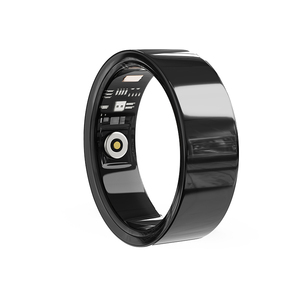
Verified Hardware Platforms
Engineered OEM/ODM Wearable Solutions
Precision-cast ceramic, Grade 5 titanium, medical silicone, and multi-sensor edge processing configurations ready for international private labeling and bespoke customization.

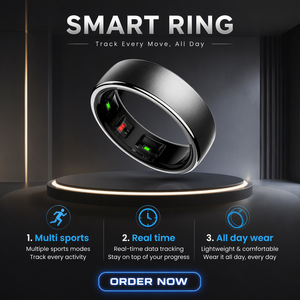
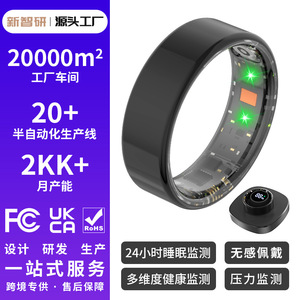
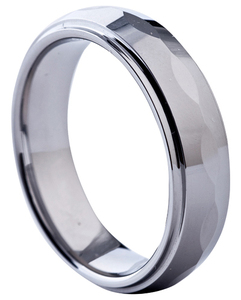
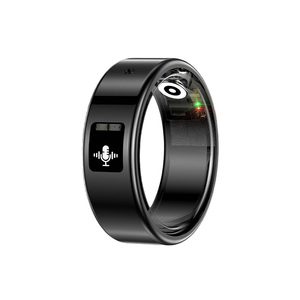
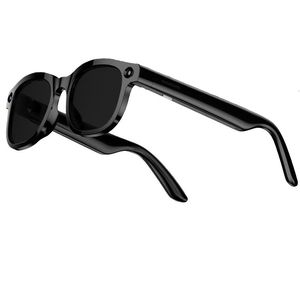
Technical Deep-Dive: HRV Tracking Architecture & PPG Sensor Engineering
Heart Rate Variability (HRV) analysis represents the physiological frontier of non-invasive autonomic nervous system (ANS) monitoring. Unlike wrist-worn wearables where optical path lengths are interrupted by radial bone structures, flexor tendons, and substantial adipose layers, the palmar digital arteries of the proximal phalanx provide an optically superior vascular bed. Top China HRV tracking smart ring factories leverage this localized vascular density to capture raw photoplethysmogram (PPG) waveforms with laboratory-grade signal-to-noise ratios (SNR).
To achieve reliable physiological metrics—specifically the Root Mean Square of Successive Differences (RMSSD), the Standard Deviation of NN intervals (SDNN), and spectral Low-Frequency to High-Frequency (LF/HF) ratios—manufacturing must adhere to stringent micro-optoelectronic tolerances. The signal acquisition chain requires balanced dynamic emitter-detector pairing. Modern high-tier Chinese OEM rings integrate dual-wavelength (525nm Green for continuous daytime motion compensation and 940nm Infrared coupled with 660nm Red for nocturnal SpO2 and HRV rest tracking) to bypass melanin absorption and tissue scattering.
RMSSD Edge Filtering
On-chip baseline drift removal and high-resolution peak detection algorithms calculate inter-beat intervals (IBI) down to ±1.5ms accuracy under resting heart rate environments.
Multi-LED Optocoupler
Dual or triple photodiode arrays placed with optical isolation barriers prevent internal casing light bleed, ensuring high modulation depth across varied dermal tones.
Sub-15μA Power Budget
Smart duty-cycling dynamically shifts sampling rates from 100Hz continuous during sleep cycle detection to burst mode, conserving lithium-polymer cell longevity.
The micro-PCB layout within a 3.0mm cross-sectional ring thickness presents profound manufacturing complexities. Tier-1 Shenzhen exporters utilize rigid-flex HDI (High-Density Interconnect) polyimide PCBs with staggered micro-vias, enclosing an ultra-low power ARM Cortex-M4 or M33 core with floating-point hardware support. Encapsulation techniques have migrated from brittle standard acrylics to medical-grade biocompatible epoxy resin potting (USP Class VI) and nano-hydrophobic conformal coatings, guaranteeing stable 5ATM and IP68 waterproof ratings capable of surviving repeated hot water immersion and galvanic sweat corrosion.
Industrial Benchmark Specifications: Tier-1 China Smart Ring Platforms
When engineering customized private-label programs, global electronics brands must align mechanical dimensions, sensor precision, and battery discharge curves with application-specific use cases. Below is the verified hardware matrix standard established by our Shenzhen advanced manufacturing facility:
| Hardware Subsystem | Standard Consumer Grade | Clinical / High-Tier OEM Specification | Procurement Impact |
|---|---|---|---|
| PPG Optical Path | Single Green LED (525nm), 1 PD | Triple Wavelength (Green, Red 660nm, IR 940nm) + Dual PD Array | Enables true nocturnal RMSSD, SpO2 & vascular compliance |
| Accelerometer Architecture | 3-Axis standard MEMS | 6-Axis Bosch / STMicroelectronics with Edge FIFO Buffer | Eliminates micro-motion artifacts during nocturnal restlessness |
| MCU & Processing | 8-bit / Basic BLE SoC | Nordic Semiconductor nRF52840 / nRF5340 or Ambiq Apollo4 Lite | On-ring cryptographic storage, local AI sleep staging algorithms |
| Internal Structural Ring | Epoxy glue mold only | Aviation Grade 5 Titanium Core / Medical Sintered Zirconia Ceramic | Eliminates sensor displacement under lateral mechanical load |
| Battery & Cycle Life | 14mAh Standard LCO Chemistry | 18mAh – 23mAh Custom Curved Li-Po, ≥80% Capacity at 500 Cycles | Provides 5 to 7 days continuous operation with 24/7 background telemetry |
Future Procurement & Technological Trends (2025–2030)
The global wearable landscape is undergoing an irreversible structural transition from bulky wristbands toward discreet finger-based telemetry. For hardware brand managers, enterprise wellness operators, and medical technology importers, strategic forecasting dictates competitive positioning. Five dominant technological vectors are reshaping current production lines in Shenzhen:
1. Edge-AI Health Inferencing
Direct integration of low-parameter neural network weights within the ring’s SoC memory permits real-time AFib screening, autonomic stress scoring, and sleep apnea classification without continuous cloud transmission.
2. Non-Invasive Blood Pressure
Advancements in Pulse Wave Transit Time (PWTT) combining localized photoplethysmogram transit differentials with high-frequency micro-pressure transducers for trend-based BP tracking.
3. Ceramic CMF Engineering
Transition from metallic coatings to nanostructured microcrystalline zirconia ceramics, offering diamond-like Vickers hardness (>1200 HV), total RF transparency, and complete hypoallergenic compatibility.
4. Solid-State Curved Batteries
Next-generation quasi-solid-state micro-cells increasing volumetric energy density by 32%, completely mitigating thermal runaway risks and extending shelf life for overseas retail supply chains.
From a procurement perspective, global supply chains are rapidly disintermediating pure assembly contractors in favor of vertically integrated development centers. The future of smart ring procurement demands turn-key firmware IP ownership, fully open Bluetooth GATT profiling, and private-label cloud APIs capable of direct FHIR/HL7 integration with hospital management software and corporate wellness applications.
Shenzhen Yt Technology: World-Class Manufacturing Infrastructure
Operating from Shenzhen—the nerve center of global micro-electronics engineering—Shenzhen Yt Technology Co., Ltd. (YT Smart Wear) has served as an industry-standard wearable OEM/ODM pioneer since 2009. We bridge the critical valley between concept ID industrial sketches and high-yield, ISO 9001 certified mass production.
2009
Established Year
50+
Wearable Patents
8+2
Assembly & SMT Lines
300K+
Monthly Ring Capacity
100+
Skilled Technicians
<5‰
Defect Ratio Limit
Unlike conventional brokers or trading entities, our full-stack manufacturing footprint eliminates inter-supplier communication latency. Industrial design (ID), mechanical modeling (MD), PCB schematic design, antenna matching networks, low-level firmware engineering, and iOS/Android application source development are held within an accountable, unified engineering team.
Our 5-Gate Comprehensive Quality Assurance Protocol
Given the skin-contact nature of 24/7 continuous health tracking, our manufacturing quality control integrates 28 discrete checkpoints across the production sequence:
Gate 01
IQC Verification
Micro-spectrometer optical binning, incoming cell impedance, and substrate surface tension testing.
Gate 02
SMT In-Line SPI & AOI
Automated optical inspection and 3D solder paste height checks on ultra-dense 01005 passives.
Gate 03
100% Function & RF
Automated optical testing fixtures calibrate PPG amplitude, SpO2 curve matching, and BLE RSSI.
Gate 04
Reliability Stress
Continuous 5ATM pressure cycling, thermal shock chamber (-20°C to 60°C), and salt spray corrosion.
Gate 05
OQC Final Audit
Microscopic cosmetic inspection, ultrasonic weld integrity verification, and battery run-down burn-in.
Our facilities are fully certified and ready to facilitate international regulatory compliance, including CE (RED), FCC Part 15C, RoHS, REACH, and UKCA approvals. In addition, every production batch is backed by an unconditional 12-month global commercial warranty, supported by dedicated English-speaking bilingual engineering managers.
Frequently Asked Questions (Procurement & Engineering)
What specific optical and algorithmic methodologies guarantee HRV accuracy?
Our hardware utilizes high-performance optical front-ends (AFE) capable of sub-microamp dark current and programmable transimpedance gain. The primary metric derived is RMSSD calculated over segmented 5-minute epochs during non-REM rest phases. By pairing dual photodiodes with active motion-canceling 6-axis accelerometer filters, ambient light noise and involuntary micro-twitches are removed prior to peak interval calculation, matching standard clinical ECG chest strap correlations at R > 0.94.
What are the minimum order quantities (MOQ) and production lead times for custom projects?
For private-label branding on established, fully-tooled hardware platforms (custom laser etching, tailored CMF colors, and localized packaging), our standard entry MOQ begins at 500 to 1,000 units with lead times of 20 to 25 calendar days. Complete bespoke ODM projects requiring custom structural injection tooling, proprietary titanium shell CNC, and dedicated PCB layout typically follow an 8-week developmental cycle (EVT/DVT) followed by 35-day mass production delivery.
How are intellectual property (IP) and proprietary algorithms protected during ODM development?
We operate under bilateral, jurisdiction-enforceable Non-Disclosure Agreements (NDA) before engineering CAD files or architecture specs are shared. Dedicated internal R&D cells handle customer-exclusive designs on segregated internal networks. Master firmware code can be flashed via encrypted bootloaders directly at our Shenzhen SMT facility, preventing third-party extraction or reverse engineering of your proprietary biometric IP.
Do you provide full-stack White-Label Companion Apps and Cloud SDKs?
Yes. We offer fully branded native iOS (Swift) and Android (Kotlin) white-label applications complete with customizable UI themes, multi-language localization, and user authentication frameworks. For enterprise clients maintaining their own existing applications, we supply comprehensive BLE API documentation, raw data stream parsing libraries, and Bluetooth GATT profiles for seamless in-house integration.
How does the factory address user skin biocompatibility and chemical safety?
Internal ring surfaces directly contacting the epidermis are cast with hypoallergenic medical-grade epoxy resins certified under ISO 10993 (Cytotoxicity, Sensitization, and Intracutaneous Reactivity standards). Metallic exterior bands utilize surgical-grade 316L stainless steel, titanium Grade 5, or zirconia ceramics, strictly adhering to EU REACH Annex XVII nickel release limits to prevent contact dermatitis during prolonged wear.
What sizing systems and sizing kit logistics are supported for international retail?
We supply turnkey sizing kit manufacturing matching US Standard sizes 6 through 14 (or European circumference standards). Sizing kits include molded plastic dummy rings with identical internal resin sensor mockups so end-users can accurately establish anatomical comfort before retail rings are shipped, drastically reducing e-commerce return rates.